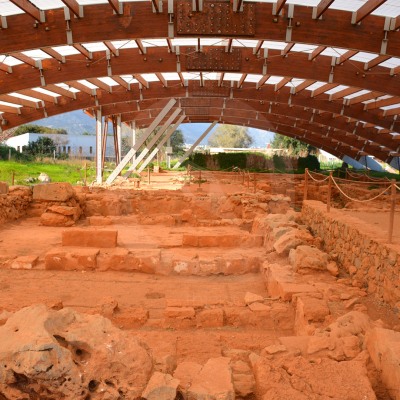
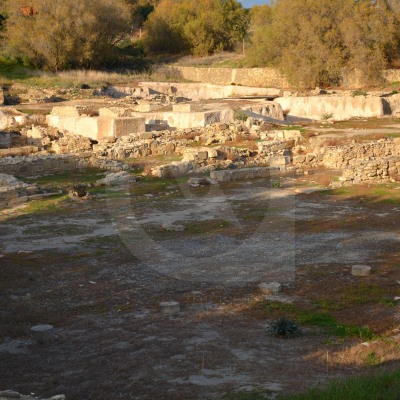
The Minoan Villa of Chamezi is one of the most distinctive and enigmatic archaeological monuments of Prepalatial and Protopalatial Crete, situated atop Souvloto Mouri hill near the village of Chamezi in Sitia.
Dating primarily to the Middle Minoan I period, the structure stands out globally for its unique elliptical shape, an architectural choice rarely seen in Minoan building traditions. Its strategic location offers unobstructed views of the entire region, suggesting its role as a lookout post or fortified residence controlling the passes of eastern Crete.
Internally, the villa is developed around a central courtyard, which was likely open-air to provide light and ventilation to the surrounding rooms. Excavations revealed numerous chambers used for living, storage, and cult purposes, as figurines and vessels associated with religious rituals were discovered. The robust wall construction and spatial layout reinforce the theory that the building was not merely a farmhouse but a local administrative and religious center with a strong defensive character, fully adapted to the rugged terrain of the hill.
Today, the archaeological site of the Chamezi Villa attracts scholars of Minoan civilization, offering valuable insights into rural life during the Minoan era. The preservation of the foundations allows visitors to grasp the complexity of the construction and the ingenuity of the Minoans in exploiting fortified positions. It is a monument that organically links historical memory with the natural environment of Lasithi, reminding us of the region's timeless significance as a crossroads of cultures and strategic control.