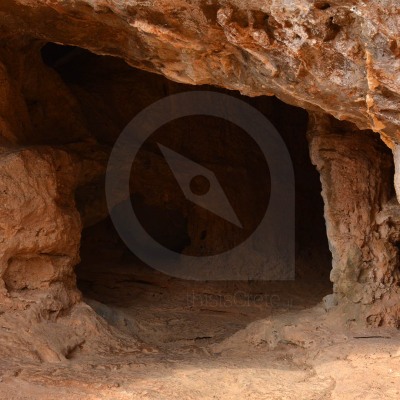
Katofygi Cave is located in eastern Crete, within the Lasithi regional unit, northwest of the village of Tourtoulous (today known as Agios Georgios) in the Sitia area.
It lies at an altitude of around 450 meters and can be reached after an uphill hike of approximately 45 minutes.
The cave is formed within Jurassic limestone and features rich speleothem decoration, including stalactites, stalagmites, and impressive columns. Its entrance is about 3.2 meters wide and is divided into two sections, while a small doline is formed just outside the entrance.
The first chamber is accessed via a steep descent of about 3.5 meters. It has a length of approximately 24 meters and a maximum width of 12 meters, and it is divided into two sections by a striking series of columns. Inside, visitors can observe small water basins and richly decorated walls.
Through a narrow and low passage, the route continues into the second chamber, which is about 42 meters long and up to 11 meters wide. This chamber is particularly rich in formations, with impressive mineral deposits covering walls and ledges.
From this chamber, four additional smaller chambers extend. In one of them, a narrow descent leads to a large underground lake, accessible only with specialized equipment and experience. The total explored length of the cave is close to 100 meters.
A short distance away lies the Small Katofygi Cave, which is also of significant scientific interest. It features a small initial chamber and a descending gallery about 40 meters long, with water basins, impressive columns, and rich formations. At its end, a narrow fissure and a steep drop likely lead to another chamber. Human and animal bones have been discovered in the cave, adding to its scientific importance.
Katofygi Cave is a remarkable natural formation in eastern Crete, combining geological beauty with scientific value, while remaining relatively unknown to the general public.